
Heat health alert updated for the South East
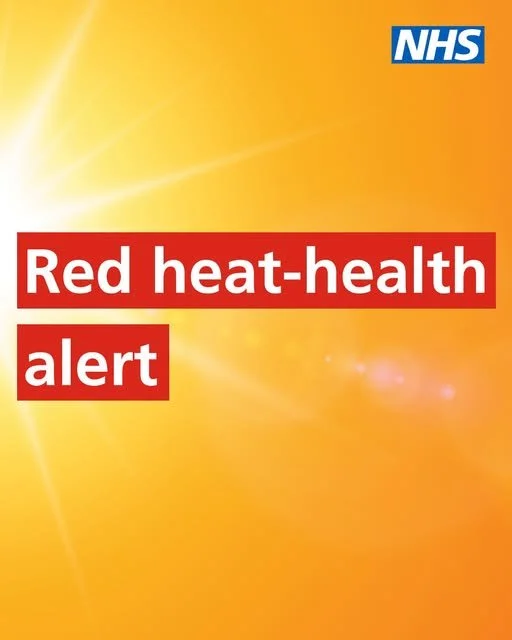
The red heat health alert is in effect from 1AM on 24/06/2026 until 11PM on 25/06/2026 across the South East. The red alert has a matrix score of 16. This means:
Severe impacts are expected across health and social care services due to the high temperatures, including:
increased risk to life across the whole population, with significant impacts on older people
significantly increased demand on all health and social care services
the heat affecting the ability of the workforce to deliver services
hot indoor environments making provision of care challenging and national critical infrastructure failures, such as generators and power outages
water-related incidents may increase, including risks from cold-water shock and drowning
You can see all the weather health alerts currently in place across England on the UKHSA data dashboard.
How to take action if you have a duty to respond
Please review the Weather Health Alert System user guidance to explain how you can use the information contained within the alerts to respond to the forecast weather.
We provide guidance on how to take action for a range of professional groups with a duty to respond, with action cards available for commissioners, health and social care providers, voluntary and community sector, and national government. Summary action cards are also available below:
· voluntary and community sector
· care homes and other residential settings
· services delivering care to people in their homes
· hospitals and other healthcare settings
For an overview of the weather alerts in place across England, please check the UKHSA data dashboard.
The Met Office may issue National Severe Weather Warnings (for example, extreme heat) with short notice, so you can take appropriate action. Check the Met Office Website to see the National Severe Weather Warnings currently in place.
You can also find information of the latest weather forecast on the Met Office website.
How to protect yourself if you are vulnerable
While exposure to hot weather can affect anyone, some people are particularly at risk. We have published guidance on staying safe during hot weather.
Planning for adverse weather
All organisations should read the Adverse Weather and Health Plan. This is important if you provide health and social care. The plan explains what you should do before and while a heat health alert is in place.
To support local planning, please check the guidance on local resilience forums.
About heat health alerts
Chief executives of the following organisations in England receive heat health alerts:
· health trust providers of NHS commissioned care
· local authorities
· social care organisations
The Heat-Health Alert Service in England runs from 1 June to 30 September each year, in partnership with the Met Office. This is the period when high temperatures are likely to occur.
If we observe high temperatures outside of this period, we will issue an extraordinary heat health alert. If this happens, stakeholders should take the usual public health actions.
You can share this email with your organisation or sign up to receive alerts using our registration form. We have a separate form if you would like to update your registration details.
Please let us know if you have a question or have a problem with your subscription. You can also unsubscribe from this service.
UKHSA and the Met Office use the Risk Matrix to assign a risk score for each alert. Users can refer the alert’s risk score to the matrix to understand the severity of the alert and likelihood of its impact.
Very low impacts
Low impacts
Medium impacts
High impacts
High likelihood
4
(green)
8
(yellow)
13
(amber)
16
(red)
Medium likelihood
3
(green)
7
(yellow)
12
(amber)
15
(amber)
Low likelihood
2
(green)
6
(green)
10
(yellow)
14
(amber)
Very low likelihood
1
(green)
5
(green)
9
(yellow)
11
(yellow)
Updates to heat health alerts
UKHSA and the Met Office make daily risk assessments. We will issue a new alert should the alert level change.
Further Advice and guidance
*******************************************************************************************
The information contained in the Email and any attachments is confidential and intended solely and for the attention and use of the named addressee(s). It may not be disclosed to any other person without the express authority of the UKHSA, or the intended recipient or both. If you are not the intended recipient, you must not disclose, copy, distribute or retain this message or any part of it. This footnote also confirms that this Email has been swept for computer viruses by Exchange Online Protection, but please re-sweep any attachments before opening or saving. UK Health Security Agency -(https://www.gov.uk/government/organisations/uk-health-security-agency)
*******************************************************************************************
This email and any attachments to it may be confidential and are intended solely for the use of the individual to whom it is addressed. Any views or opinions expressed may not necessarily represent those of West Berkshire Council. If you are not the intended recipient of this email, you must neither take any action based upon its contents, nor copy or show it to anyone. Please contact the sender if you believe you have received this e-mail in error. All communication sent to or from West Berkshire Council may be subject to recording and or monitoring in accordance with UK legislation, are subject to the requirements of the Freedom of Information Act 2000 and may therefore be disclosed to a third party on request.
Publichealthandwellbeing<Publichealthandwellbeing@westberks.gov.uk>
Helena Fahie
Dear Colleagues,
Please be informed that the UK Health Security Agency has issued a red heat-health alert for the South East, which covers West Berkshire.
The alert is in effect from 1AM on 24/06/2026 until 11PM on 25/06/2026 across the South East. The red alert has a matrix score of 16.
As published on the heat-health alert dashboard, this means that severe impacts are expected across health and social care services due to the high temperatures, including:
increased risk to life across the whole population, with significant impacts on older people
significantly increased demand on all health and social care services
the heat affecting the ability of the workforce to deliver services
hot indoor environments making provision of care challenging and national critical infrastructure failures, such as generators and power outages
water-related incidents may increase, including risks from cold-water shock and drowning
You can see all the weather health alerts currently in place across England on the UKHSA data dashboard.
Anyone can feel unwell in hot weather, but some groups face higher risks of bad health. This may be due to their medical conditions, or because their ‘building blocks of health’ are unsuitable – e.g. housing conditions, working environment, or support in the community. Hot weather can also put pressure on health and care services or disrupt how they are delivered.
Many of the risks and impacts are predictable and preventable:
Be aware of which populations face greater health risks in hot weather, how to keep homes and indoor spaces cool, the symptoms of heat-related illness, and how to cool down – see below for a range of public health guidance and resources.
Ensure your colleagues, team members and key stakeholders are aware of what to do now and if the alert level is further raised – see the action cards and other guidance applicable to your setting.
Communicate to service-users about the health risks of hot weather, the simple actions they can take to Beat the Heat, and look out for people who may struggle to keep themselves cool and hydrated.
Cascade information through your networks on how to reduce the health risks associated with hot weather.
Key groups at risk from hot weather
(For details, see Section 4.2 of Supporting Evidence of the AHWP)
older people (aged 65 years and over)
babies and young children (particularly those aged 5 years and under)
people with health conditions, including: heart problems, breathing problems, dementia, diabetes, kidney disease, Parkinson’s disease, mobility problems or a mental health condition
pregnant women (potential risk of preterm birth)
people on certain medications that potentially affect heart or kidney function, cognition, or ability to sweat
people who are already ill and dehydrated (for example, from diarrhoea and vomiting)
people who experience alcohol or drug dependence
people who live alone and may be unable to care for themselves
people who are physically active and spend a lot of time outside
people who work in jobs that require manual labour or extensive time outside
people experiencing homelessness, including rough sleepers and those who are unable to make adaptations to their living accommodation such as sofa surfers or those living in hostels
Resources
Specific guidance on supporting vulnerable people
Supporting vulnerable people before and during hot weather: social care managers, staff, and carers
Supporting vulnerable people before and during hot weather: healthcare professionals
Supporting vulnerable people before and during hot weather: people homeless and sleeping rough
Hot weather and heatwaves: guidance for schools and other education settings
Action and summary cards for professionals when heat-health alerts are issued
For health and social care providers (action / summary for providers of home care; hospital and community care; care homes and other adult social care settings)
Event organisers
Hot weather advice: mass gatherings and planning events
Easy read guidance
Public advice – staying safe in hot weather
Training for health and care professionals
The All Our Health series providing eLearning to educate and train the health and care workforce
The climate change module has a bite-size session on of climate and health
West Berkshire Council website
NHS advice
Sunlight
Defra’s UV monitoring in Reading
Children’s safety
Water safety
Advice from Royal Berkshire Fire and Rescue Service
Air quality
Met Office resources
Thank you for your work supporting the community during hot weather.
Should you have any questions or feedback, please feel free to write to us Publichealthandwellbeing@westberks.gov.uk.
Kind regards,
Dr Matt Pearce PGDip MPH PhD FFPH
Director of Public Health West Berkshire Council and Reading Borough Council
